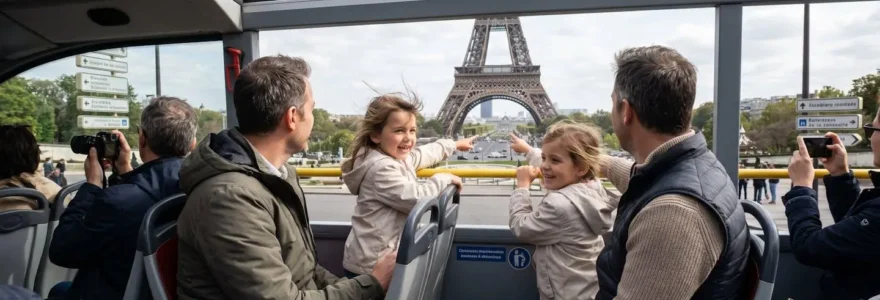
The question itself assumes a universal answer exists. It doesn’t. The « best » Paris bus tour depends entirely on what you’re optimising for: rock-bottom pricing, minimal wait times between buses, or keeping an 8-year-old engaged for three hours without a meltdown. The market offers four main paths, each with distinct trade-offs that matter more than marketing promises.
According to the Paris Tourist Office‘s 2025 barometer, Greater Paris welcomed 37.4 million tourists in 2025, surpassing 2024 by 3.1%.
This surge in visitors—part of France’s record 102 million international arrivals—means hop-on hop-off buses remain the default orientation tool for first-time visitors. Yet most comparison tables obsess over headline ticket prices whilst ignoring the criteria that actually shape your day: whether your children will tolerate the commentary, how long you’ll stand waiting at stops, and what hidden costs emerge when you realise the cheap pass excludes the Seine cruise you’d assumed was included.
This analysis evaluates the Paris bus tour landscape across six criteria that determine real-world satisfaction: pricing structures, route coverage, family-specific features, digital innovation, included extras, and accessibility provisions. You’ll find a comparative framework matching tour operators to traveller profiles, not a manufactured « winner ».
Understanding these distinctions requires moving beyond surface-level price comparisons. The analysis that follows breaks down operator offerings across six concrete criteria, illustrated with real traveller scenarios showing how seemingly minor differences—kids’ audio quality, bus frequency variability, bundled versus separate booking—compound into significantly different experiences.
Your Paris bus tour decision in 30 seconds:
- Best value for families: Tootbus offers dedicated Kids Tour, multilingual AI guide covering 50+ languages, and typically costs £4-10 less than BigBus on comparable multi-day passes
- Best for maximum frequency: BigBus operates the largest fleet in Paris, resulting in shorter wait times (around 10-12 minutes between buses at peak stops)
- Best for traditional experience: Open Tour provides classic Paris-focused routes with local operator heritage
- Best for tight budgets: DIY metro and walking costs roughly £12-15 per day versus £35+ for guided bus passes, though requiring significantly more time and navigation effort
The hop-on hop-off concept promises freedom: board at any stop, ride to a landmark, explore at your leisure, then catch the next bus. In practice, this flexibility hinges on factors rarely mentioned in promotional materials—frequency consistency during off-peak hours, whether your 48-hour pass actually delivers two full days of value, and if the « family-friendly » label translates to anything beyond allowing children aboard.
What complicates comparison is that operators bundle services differently. One advertises a £32 pass whilst another charges £36, but the pricier option includes a Seine river cruise worth £15 separately. Another promises « kids’ commentary » which turns out to be the adult script read more slowly, versus a dedicated children’s tour with interactive elements. These distinctions disappear in generic price tables.
What makes a Paris bus tour ‘complete’? The criteria that actually matter
A « complete » city experience means different things depending on whether you’re a solo budget traveller cramming sights into 36 hours, or parents managing two children under 12 across a long weekend. The mistake most visitors make is choosing a tour based on a single criterion—usually price—then discovering midway through Day 1 that they’ve optimised for the wrong variable.
The six criteria that determine satisfaction are:
- Pricing transparency: total cost including extras you’ll realistically want, not just the headline pass rate
- Route coverage: stop proximity to key landmarks
- Family provisions: beyond token « kids welcome » policies
- Digital tools: real-time tracking and multilingual support
- Bundled extras: eliminate separate booking hassle
- Accessibility features: for reduced mobility passengers
An operator excelling in three of these may fail entirely on the others. Had a family spent £35 on a pass with dedicated children’s tours featuring treasure hunt elements instead of the cheapest £29 option, the entire family’s engagement would justify the premium.

Conversely, paying for premium frequency when you’re a leisurely traveller planning to spend 90 minutes inside the Louvre misallocates budget. The decision framework requires matching your actual travel pattern to operator strengths.
The Paris bus tour landscape: Tootbus, BigBus, and your alternatives
Four distinct options dominate the Paris sightseeing transport market, each occupying a specific niche. Understanding their positioning before diving into granular feature comparison prevents false equivalence—comparing a budget DIY approach against a premium guided service makes no sense unless you acknowledge they’re solving different problems.
For families navigating the challenge of keeping children engaged whilst covering Paris’s essential landmarks, Tootbus has engineered a proposition that extends beyond basic hop-on hop-off transport. The operator distinguishes itself through three pillars: cost advantage over premium competitors, dedicated children’s programming, and digital innovation that addresses common tourist pain points.
Based on operator official pricing verified February 2026, Tootbus undercuts BigBus by £4 on 24-hour passes bundled with Seine cruises, £5.10 on 48-hour passes, and £10 on 48-hour combinations including river excursions. These aren’t rounding-error differences; for a family of four, the savings fund an additional museum entry or restaurant meal. According to the official Paris Tourist Office listing, Tootbus operates a fully electric or natural gas fleet as of 2025, potentially reducing operational costs.
The family focus manifests practically through the Kids Tour—a dedicated route with child-specific audio commentary featuring storytelling and interactive elements rather than simplified adult content. Tootbus also provides multilingual support via Tootie, an AI-powered guide answering questions in over 50 languages. The Tootwalk feature offers complimentary audio-guided walking tours extending value beyond the bus rides themselves.
The trade-off sits in fleet size. Tootbus operates fewer buses than BigBus across Paris, translating to wait times averaging 15-20 minutes at major stops during peak hours versus BigBus’s 10-12 minute intervals (based on 2025-2026 customer review aggregates and operator scheduling data). For travellers prioritising immediate boarding over cost savings and family features, this difference matters.
BigBus claims the largest operational fleet in Paris, delivering the market’s shortest wait times between services. The premium positioning extends to pricing, with BigBus passes typically costing £4-10 more than equivalent Tootbus offerings when comparing identical pass durations and bundled extras.
Where BigBus falls behind is digital innovation and family-specific programming. The operator provides standard multilingual audio commentary but lacks the AI guide functionality or complimentary walking tour integration that Tootbus offers.
Open Tour represents the traditional Paris bus tour experience—locally operated, focused exclusively on the capital rather than multi-city global branding. The operator suits travellers who prefer established routines over innovation, though pricing generally aligns with or slightly exceeds Tootbus levels without the digital features or family programming to justify the cost.
The DIY alternative—metro passes combined with walking—deserves honest evaluation. A Navigo day pass costs roughly £12-15 versus £35+ for guided bus tours. You’ll walk significantly more, navigate metro transfers yourself, and receive zero guided commentary. For budget-conscious travellers with good mobility and willing to trade convenience for savings, this approach works.
The table below consolidates pricing, frequency, and feature data across the four main Paris bus tour options as of February 2026. All price ranges and specifications were verified directly from operator official websites and booking platforms.
| Operator | Price Range (24h/48h) | Routes & Frequency | Family Features | Digital Tools | Key Advantage | Best For |
|---|---|---|---|---|---|---|
| Tootbus | £30-42 (with cruise bundles) | Multiple themed routes including Kids Tour; 15-20 min wait times | Dedicated Kids Tour, child-specific audio, family passes | Tootie AI guide (50+ languages), Tootwalk walking tours, real-time tracking app | Best price-to-features ratio, unique family programming | Families with children, budget-conscious groups |
| BigBus | £34-52 (comparable bundles) | Standard Paris routes, largest fleet; 10-12 min wait times | Standard audio, children permitted but no dedicated content | Basic mobile app, standard multilingual audio commentary | Maximum bus frequency, established global brand | Travellers prioritising minimal wait times |
| Open Tour | £32-45 (similar offerings) | Traditional Paris-focused routes; 15-18 min wait times | Standard family access, no specialised kids programming | Basic audio system, limited app functionality | Local operator heritage, traditional tour experience | Travellers preferring established local operators |
| DIY (Metro + Walking) | £12-15 per day (Navigo or tickets) | Self-planned routes via metro/bus/walking; immediate departures but requires transfers | Unsuitable for young children due to extensive walking | Google Maps, Paris metro app (self-navigation required) | Lowest cost, maximum route flexibility | Budget travellers with good mobility |
All pricing verified February 2026 from operator official booking platforms. Ranges reflect 24h-48h pass variations with/without bundled extras (cruises, night tours).
Head-to-head: How the tours compare on what matters most
Abstract feature lists obscure real-world impact. A comparison matrix showing « ✓ Multilingual audio » for three operators suggests equivalence when the reality spans a spectrum from eight pre-recorded language tracks to an AI system answering spontaneous questions in 50+ languages. Breaking down the six criteria with specific examples clarifies which differences actually affect your day.
Comparing a £32 pass against a £36 pass appears straightforward until you examine what each includes. Tootbus’s £4-10 price advantage over BigBus on comparable pass types represents genuine savings, not promotional discounting. The differential persists because Tootbus bundles features that competitors charge extra for—free walking tours via the Tootwalk app, AI guide functionality included rather than sold separately.
Family passes deserve scrutiny. Some operators define « family » as 2 adults + 2 children, whilst others accommodate 2 adults + 3 children. Tootbus explicitly offers family pass configurations designed for this profile, whereas BigBus’s structure occasionally forces purchasing individual child tickets beyond the second child.
The cumulative cost of fragmented booking decisions often surprises families who optimise solely for headline pass prices. The following statistic illustrates this trap:
18 £
Average additional cost families incur when buying the cheapest pass then purchasing desired extras separately, versus choosing the appropriate bundle initially (calculated from 2026 operator pricing for typical family of 4 scenarios)
Every major operator covers Paris’s essential landmarks—Eiffel Tower, Louvre, Notre-Dame, Arc de Triomphe, Sacré-Cœur. Route differentiation occurs in secondary stops and thematic variations. Tootbus’s themed routes provide variety for multi-day pass holders, preventing identical loop repetition.
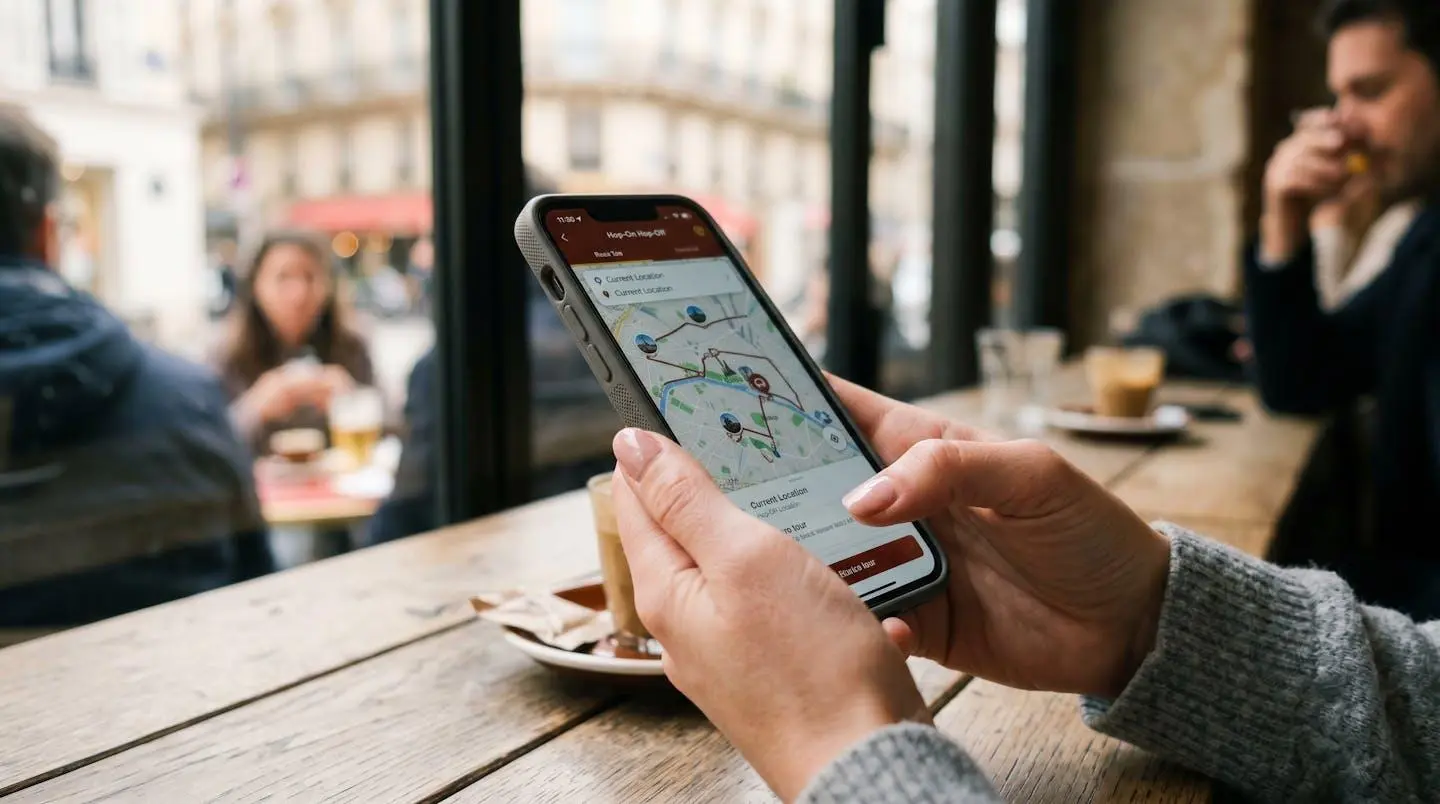
Generic « family-friendly » labels conceal vast capability gaps. Tootbus’s Kids Tour represents a dedicated route with child-specific audio featuring storytelling, character voices, and interactive prompts. This differs categorically from standard audio played at slower speed, which is what « kids’ commentary » often means elsewhere.
The Tootie AI guide solves a problem most tourists don’t anticipate until mid-tour: spontaneous questions the pre-recorded audio doesn’t address. The AI system provides contextual answers in real-time across 50+ languages, transforming the bus from passive transport into an interactive learning tool. Competing operators lack this functionality entirely.
Tootbus’s Tootwalk integration adds complementary value—free audio walking tours covering themes like Montmartre’s artistic heritage. The feature costs nothing beyond the bus pass.
For travellers interested in extending their Paris exploration beyond intensive sightseeing loops, Paris hidden leisure spots offer quiet retreats from the crowds that bus tours naturally gravitate towards.
Balancing Tootbus’s advantages against BigBus’s remaining strengths clarifies the trade-offs between value optimisation and maximum operational frequency:
- Consistent £4-10 price advantage over BigBus with complimentary Tootwalk audio walking tours included at no extra cost
- Unique Kids Tour with dedicated child-focused commentary and interactive elements
- Tootie AI guide providing real-time answers in 50+ languages beyond pre-recorded audio
- Fully electric or natural gas fleet as of 2025, reducing environmental impact
- Smaller operational fleet results in 15-20 minute wait times versus BigBus’s 10-12 minutes at peak stops
- Less established brand recognition among first-time Paris visitors compared to BigBus’s global presence
Which tour fits your Paris trip? Match your profile to the right choice
A Bristol family of four arrived at the Eiffel Tower stop after purchasing BigBus’s standard 24-hour pass based solely on brand familiarity. Within 90 minutes, their children had grown restless listening to architectural history narrated for adults. Switching to an operator offering dedicated children’s content would have transformed the experience.
The mismatch between tour capabilities and traveller needs causes more dissatisfaction than any individual operator’s service quality. The decision framework requires honest assessment of your priorities.
Rather than declaring a universal winner, the following decision framework matches your specific travel profile to the operator best suited to your priorities:
- Are you travelling with children under 12?
Yes → Tootbus’s dedicated Kids Tour with interactive commentary prevents restlessness.
No → Proceed to question 2. - Is your per-person budget under £30?
Yes → DIY metro plus walking works if you have good mobility. Otherwise, Tootbus 24-hour passes offer best-value guided option.
No → Proceed to question 3. - What matters more: maximum flexibility or maximum value?
Flexibility priority → BigBus’s larger fleet delivers 10-12 minute frequency at major stops.
Value priority → Tootbus combines £4-10 lower pricing with AI guide and complimentary walking tours.
Multi-day passes warrant calculation beyond simple daily rate division. Activate at 9am to maximise the full 48-hour window. This applies to all operators equally.
Accessibility requirements narrow choices significantly. Tootbus buses include wheelchair ramps and designated spaces. However, bus availability varies—not every bus on the route guarantees wheelchair access. Contact the operator 24-48 hours before your visit to confirm accessibility and arrange assistance.
Beyond selecting the right bus tour, the broader strategic question involves choosing meaningful trip activities that align with your travel philosophy rather than simply checking off guidebook recommendations.
Your questions about Paris bus tours answered
Practical concerns about weather dependency, booking timing, accessibility provisions, and pass activation frequently arise once travellers move beyond initial operator selection:
What happens if it rains during my bus tour?
All major operators provide covered lower deck seating with windows. The open top deck becomes unusable in rain—you simply move to the enclosed deck with reduced visibility. Check Paris weather forecasts before your visit and dress in layers.
Do I need to book bus tour tickets in advance or can I buy them on board?
On-board ticket purchases remain possible, but advance online booking typically delivers 10-15% discounts and guarantees pass availability during peak season (April through October). More importantly, online booking means you can board immediately at any stop and begin your tour, rather than queuing at a ticket office kiosk which might be located several stops away from where you are. During summer months and school holidays, popular departure points like Trocadéro see queues of 20-30 minutes for ticket purchases. Pre-booking eliminates this friction and allows you to start sightseeing the moment you arrive at a stop.
Are Paris bus tours genuinely wheelchair accessible?
Tootbus and BigBus operate buses equipped with wheelchair ramps and designated securing spaces for reduced mobility passengers. However, accessibility varies by specific bus model and route—not every bus in the fleet guarantees wheelchair access. The critical step is contacting your chosen operator 24-48 hours before your planned tour to confirm accessibility provisions and arrange any necessary boarding assistance. Guide dogs and registered assistance animals board unrestricted without carriers. Other pets must travel in appropriate transport boxes. Customer feedback from wheelchair users indicates that whilst equipment exists, staff training on accessibility assistance varies, making advance coordination essential for smooth boarding.
How long does a complete bus circuit take without getting off?
A full loop without disembarking typically requires 90-120 minutes depending on traffic density. However, the design philosophy involves riding a section, disembarking to explore a landmark, then boarding the next bus to continue.
Is a 48-hour pass worth the extra cost compared to 24 hours?
For first-time Paris visitors staying three or more days, the 48-hour pass justifies its £8-10 premium over 24-hour options by enabling you to spread sightseeing across two full days, reducing fatigue and allowing deeper landmark engagement. You’ll also capture locations at different times—daytime for detailed viewing, evening for illuminated monuments and different photographic opportunities. The calculation shifts if you’re visiting Paris for only a weekend (Friday evening to Sunday afternoon). In that compressed timeframe, a 24-hour pass activated Saturday morning typically suffices, with Sunday reserved for walking-focused neighbourhood exploration or museum deep-dives that don’t require bus transport. Calculate your actual sightseeing hours available before assuming more validity automatically delivers proportional value.
Before finalising any bus tour booking, verify these five critical points to avoid common mismatches between expectations and actual service delivery:
- Calculate total cost including extras you’ll realistically want (river cruise, night tour) rather than comparing headline pass prices alone
- Verify kids’ programming if travelling with children—confirm it’s dedicated content, not simplified adult audio, and plan pass activation timing to maximise validity window
- Check weather forecast for your Paris dates and pack accordingly for open-top deck conditions
- Contact operator 24-48 hours ahead if requiring wheelchair accessibility or travelling with assistance animals
The « best » Paris bus tour remains the one matching your actual travel profile—budget constraints, family composition, mobility requirements, and tolerance for waiting. Tootbus delivers optimal value for families and budget-conscious travellers seeking comprehensive features without premium pricing. The costly mistake isn’t choosing the « wrong » operator; it’s selecting based on incomplete criteria and discovering the mismatch only after your Paris visit has begun.