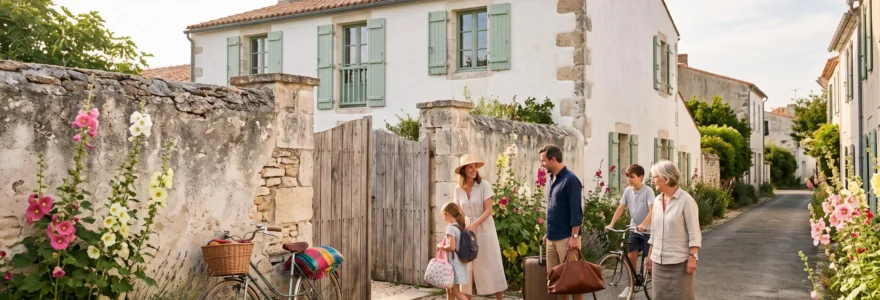
To rent a private villa on Île de Ré, you’ll get the best result by doing three things in order: pick the right village for your stay, match your dates to seasonal demand, then confirm the booking conditions (contract, payment, deposit, and local taxe de séjour) before you pay.
This guide is built for first-timers: you’ll learn what “private villa” really means on the island, how to compare areas without guesswork, and what to check so your private villa rental Île de Ré plan feels solid rather than risky.
Your Île de Ré villa booking game plan
- Start with location: village vibe (ports, beaches, quiet lanes) shapes your week more than interior décor.
- Assume seasonality:</strong availability and prices move with school holidays and summer peaks (don’t rely on “standard” rates).
- Ask for clarity in writing:</strong what’s included (linen, cleaning), what’s extra, and the cancellation terms.
- Check local compliance signals:</strong a declared “meublé de tourisme” and a clear approach to taxe de séjour collection are reassuring.
- Do a final cross-check:</strong listing vs contract vs messages before you send a deposit.
What Makes a Private Villa on Île de Ré Different?
Direct answer: On Île de Ré, a “private villa” usually means a standalone home with outdoor space (often a walled garden, sometimes a pool), more privacy, and fewer shared areas than a typical holiday flat or village house.
The key difference is how it changes your daily life: you’re not adapting to communal spaces or shared entrances, and you can organise your days (meals, naps, swim times, bikes) around your own base.
In local French administrative language, many holiday homes fall under “meublé de tourisme” (furnished tourist accommodation). On the island, communes can require owners to declare these rentals. For example, the official website of La Couarde-sur-Mer states that anyone commercialising accommodation for rental must declare it via the DECLALOC platform, as part of the déclaration obligatoire des meublés de tourisme.
Villa vs village apartment: what changes for you day to day?
Direct answer: Choose a villa if you want space and independence; choose a village apartment if you want walk-everywhere convenience and don’t mind sharing walls or entrances.
A villa with a garden (and possibly a pool) is ideal if your group needs room to spread out, you’re travelling with children, or you plan long lunches at home. You’re paying for privacy and comfort, not just square metres.
A village apartment can make evenings simpler: you step outside and you’re in the centre. The trade-off is typically less outdoor space and less “buffer” from summer noise.
What a “private villa” listing should make clear:
- Exclusive use of the property (no shared garden/driveway unless explicitly stated).
- Outdoor setup (enclosed garden, terrace, pool safety features if there is a pool).
- Practicalities: parking, bike storage, linen/cleaning arrangements, and any neighbour proximity that could affect noise.
Which Area of Île de Ré Should You Choose?
Direct answer: Pick your base by matching your profile (family beach week, couple’s quiet break, group cycling trip) to a village’s atmosphere—ports and heritage for lively evenings, beach villages for easy days, or quieter spots if you want calm nights.
Île de Ré is small, but your experience can feel completely different depending on where you stay. The official Destination Île de Ré tourist office highlights distinct village identities—use that as a reality check when listings all start to look the same.

As a starting point, Destination Île de Ré describes Saint-Martin-de-Ré as the island’s historic capital, notes Le Bois-Plage-en-Ré as popular with families, and presents La Couarde-sur-Mer as family-oriented too; it also points out that Ars-en-Ré is listed among “the most beautiful villages of France”. Those snapshots are useful when you’re choosing between “close to beach” claims in multiple listings—see the tourist office page on profils distincts des villages rétais.
A quick “village-to-stay” grid by traveller profile
Direct answer: Use this grid to narrow your shortlist to 2–3 villages, then compare villas only inside those areas.
| Your priority | Villages that often fit (based on official village profiles) | What to check in villa listings |
|---|---|---|
| Family beach days + simple logistics | Le Bois-Plage-en-Ré; La Couarde-sur-Mer | Enclosed outdoor space, shade, bike storage, walkable access to beach/shops |
| Heritage, harbour walks, restaurants nearby | Saint-Martin-de-Ré; Ars-en-Ré | Parking/bike parking, evening noise risk, distance to harbour centre (on foot) |
| Quiet, privacy, “villa life” (garden routines) | Look for residential lanes near your preferred village | Neighbour proximity, pool safety notes, check-in/out flexibility |
| Cycling-focused days across the island | Any central base can work; prioritise easy bike routes from the door | Secure bike storage, repair kit availability (if provided), safe access to cycle paths |
Cas pratique
A hypothetical example: you’re a couple looking for calm mornings and charming harbour walks, but you also want to cycle daily. You shortlist Ars-en-Ré for its character and Saint-Martin-de-Ré for its lively centre. Your decision rule becomes concrete: pick Ars-en-Ré if you prefer quieter evenings and village charm; pick Saint-Martin if you want more nightlife and easy restaurant choice—then only compare villas that clearly state parking and secure bike storage.
How to Book a Villa on Île de Ré Without Surprises
Direct answer: Book safely by following a simple sequence: define non-negotiables, verify the property’s status and taxe de séjour handling, get every cost and condition in writing, then pay only through a traceable method aligned with the contract.
This matters because a private villa rental can look similar across listings, while the “real value” comes from conditions: what’s included, how arrivals work, and what happens if plans change.

Step-by-step: from shortlist to confirmed booking
Direct answer: If you can’t confirm the essentials (total cost, cancellation, inventory, taxe de séjour) before paying, don’t treat it as “normal”—treat it as missing information.
- Set your non-negotiables first
Capacity, number of bedrooms, outdoor space, pool (if needed), parking, and bike storage. This stops you overpaying for features you won’t use.
- Ask for a full cost breakdown in writing
Request clarity on what’s included (cleaning, linen, heating if relevant) versus optional extras. If something is “to be confirmed”, ask when and how it will be confirmed.
- Check compliance signals (don’t guess)
In at least some communes on the island, owners must declare furnished tourist accommodation when they commercialise it. The commune of La Couarde-sur-Mer explicitly describes this obligation on its official site; use that as a prompt to ask the owner/agency how the property is declared and how local taxes are handled.
- Get (and read) the rental contract before paying
Verify dates, address, maximum occupancy, house rules, cancellation terms, deposit/caution conditions, and what happens in case of late arrival.
- Pay in a traceable way aligned with the contract
Match payment steps to the written terms. If the requested payment method or timeline differs from the contract, pause and clarify before sending funds.
How do booking conditions and the taxe de séjour work?
Direct answer: Expect booking conditions to cover payment schedule, a security deposit (often called a “caution”), cancellation rules, and local tourist tax collection (taxe de séjour). The exact practice depends on the commune and who collects it (owner, agent, platform).
Taxe de séjour is a local tourist tax that applies to paid stays. What you should do is simple: ask who collects it, when it’s due, and how it will be itemised (invoice line, receipt, or platform breakdown). If the answer is vague, treat it as a reason to slow down.
Scope to keep in mind: booking advice reduces risk but doesn’t guarantee availability, price, or the outcome of a stay—always rely on the written contract and documented exchanges.
How do villa prices vary between high and low season?
Direct answer: On Île de Ré, villa pricing is strongly seasonal: high-demand periods (especially summer and school holidays) tend to be more expensive and book earlier, while shoulder seasons can offer more choice.
It would be misleading to give you a “typical” weekly villa price without an official, villa-specific dataset in the sources provided. What you can rely on is the mechanism: demand shifts with the calendar, and villas with features like pools and large gardens are often positioned in the higher end of the seasonal rental market.
If you want a reality check on broader summer dynamics in the region, Charentes Tourisme reports that summer 2025 tourism in the Charentes (which includes Île de Ré) declined compared with 2024; see the bilan touristique estival des Charentes. This doesn’t tell you villa prices, but it helps you avoid assuming demand is always “up only”.
How far in advance should I book a villa on Île de Ré for high season?
Direct answer: For high season, plan to book as early as you reasonably can once your dates and village are fixed, because the best-matching villas (capacity + location + outdoor space) are limited.
Rather than focusing on a number of months (we don’t have a source-backed figure here), use a decision rule: if you’re travelling during school holidays or you need a specific setup (pool, several bedrooms, enclosed garden), treat it as a “book early” scenario. If you’re flexible on dates and features, you can afford to compare longer.
Planning Your Stay Around the Island’s Rhythms
Direct answer: Plan your week around seasonality and mobility: in busy periods, build in earlier starts and bike-first routes; in quieter periods, expect fewer opening hours but easier parking and calmer beaches.
Once your villa is booked, the biggest quality-of-stay upgrade comes from realistic planning: how you’ll move around (often by bike), and how you’ll structure days to avoid peak-hour friction.
A “high-season day” that keeps things simple
Direct answer: The simplest high-season routine is: morning errands/market early, beach late morning, villa break mid-afternoon, harbour stroll or dinner later.
Here’s a practical template you can adapt: start with an early bike ride to the market or bakery, then head to the beach before it feels crowded. Keep the middle of the day for the villa (lunch, shade, pool time if you have one), then go out again later for a port walk and dinner.
If your group includes children, that mid-afternoon villa break is often what makes a private villa “worth it”: you’re not forced to stay out all day, and you’re not trying to squeeze naps into a café schedule.
Getting around: what to decide before you arrive
Direct answer: Decide two things upfront: whether you’ll be bike-first most days, and how much you’ll rely on a car for shopping or day trips.
When you compare villas, look beyond “near the beach” and check what affects daily movement: safe bike storage, whether the lane feels comfortable to exit by bike, and parking conditions if you’re driving.
If you want a broader mindset on why people choose holiday rentals for comfort and routine, you can also read this internal piece on holiday rentals.
What Should You Check Before Confirming Your Reservation?
Direct answer: Before you confirm, cross-check the listing, the contract, and your message thread—then make sure payment timing, deposit/caution terms, and arrival/departure details are written and consistent.
This is the moment where you prevent most “but we thought…” problems. Don’t look for perfection; look for alignment between what was advertised and what is contractually agreed.

Your final checklist (copy/paste before you pay)
Direct answer: If you can’t tick every box, ask the question before you transfer money—don’t assume it will be fine.
- Identity & address: exact property address (or at least confirmed village area) and the name of the contracting party.
- Capacity: maximum occupancy and bed setup matches your group (including children/babies).
- What’s included:</strong cleaning, linen, towels, heating (if relevant), pool maintenance (if relevant).
- Taxe de séjour:</strong who collects it, when it’s paid, how it’s itemised.
- Deposit/caution:</strong amount or method (hold/cheque/transfer), conditions for retention, and timing for return.
- Cancellation:</strong deadlines and what happens to paid amounts (deposit, instalments, fees).
- Arrival/departure:</strong check-in window, key handover method, late arrival procedure, and check-out steps.
- Inventory:</strong whether an inventory/état des lieux is planned at arrival and departure.
How do you rent a private villa on Île de Ré?
Pick a village that matches your stay (family beach week, couple’s harbour break, group trip), shortlist villas with clear essentials (capacity, outdoor space, parking/bike storage), then ask for a written cost breakdown and the rental contract before paying. Confirm how taxe de séjour is collected and make sure the listing, contract, and messages all match.
Which village on Île de Ré is best for a family villa holiday?
If you want a family-oriented base, the official Destination Île de Ré tourist office presents Le Bois-Plage-en-Ré and La Couarde-sur-Mer as popular with families. Use that as your starting shortlist, then choose based on your villa priorities (enclosed garden, shade, short bike rides to the beach, simple shopping access).
How can I compare villa rentals on Île de Ré without overpaying?
Compare like-for-like: same village (or immediate surroundings), similar capacity, and the same must-haves (pool, enclosed garden, parking). Then compare the “conditions bundle”: what’s included (linen/cleaning), cancellation terms, deposits, and arrival logistics. A cheaper headline rate can cost more if key items are extra or if terms are restrictive for your plans.
What should I check before paying a villa deposit?
Check that the contract is complete (dates, address, occupancy, total cost, cancellation), that the deposit/caution terms are written, and that taxe de séjour handling is clear. If anything differs between the listing and the contract, ask for a corrected document before you pay, and always use a traceable payment method consistent with the contract.
If you want a confident private villa rental Île de Ré experience, your best next step is simple: pick two villages that fit your stay, then apply the same checklist to every villa you consider. You’ll compare faster, ask better questions, and avoid paying for surprises.